Most drivers on the road today are aware of a crucial component of their car’s exhaust system called the catalytic converter. This part is an emissions control device responsible for converting harmful exhaust gasses into water vapor and carbon dioxide. If you wish to unclog or clean the catalytic converter at any point, use these tips below.
What Is A Catalytic Converter?
Catalytic converters initially made their appearance in the middle of the seventies and fast began to be used globally. It is a part of a vehicle’s exhaust system that turns bad engine-exhaust contaminants into a less damaging exhaust to the atmosphere using a chemical reaction. A lot of nitrogen oxides, CO, and hydrocarbons, turn into the “less harmful” nitrogen, CO, and water vapors.
Driving around devoid of one would be very detrimental to the environment. Regrettably, thieves don’t care about that and would happily steal it off your vehicle for its monetary value.
Where Is The Catalytic Converter Located?
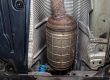
You will be able to find one or more catalytic converters in your car’s exhaust system situated between the engine and the muffler(s). If there happens to be a converter located near (or inside) the exhaust manifold, this is referred to as the “pre-cat”. The converter located closest to the muffler, meanwhile, is deemed the “main cat”.
The pre-cat will warm up quickly in order to increase the main cat’s efficiency. Car’s featuring an engine with a ‘V’ or flat configuration will typically have a catalytic converter or two for each side of the engine. This does mean the car can have up to four catalytic converters.
When the engine has two banks of cylinders, typically in a ‘V’ or flat layout, the converters are found on the side of the engine with the number cylinder called the bank 1 converters. Bank two converters will be located on the opposite side.
How To Access The Catalytic Converter
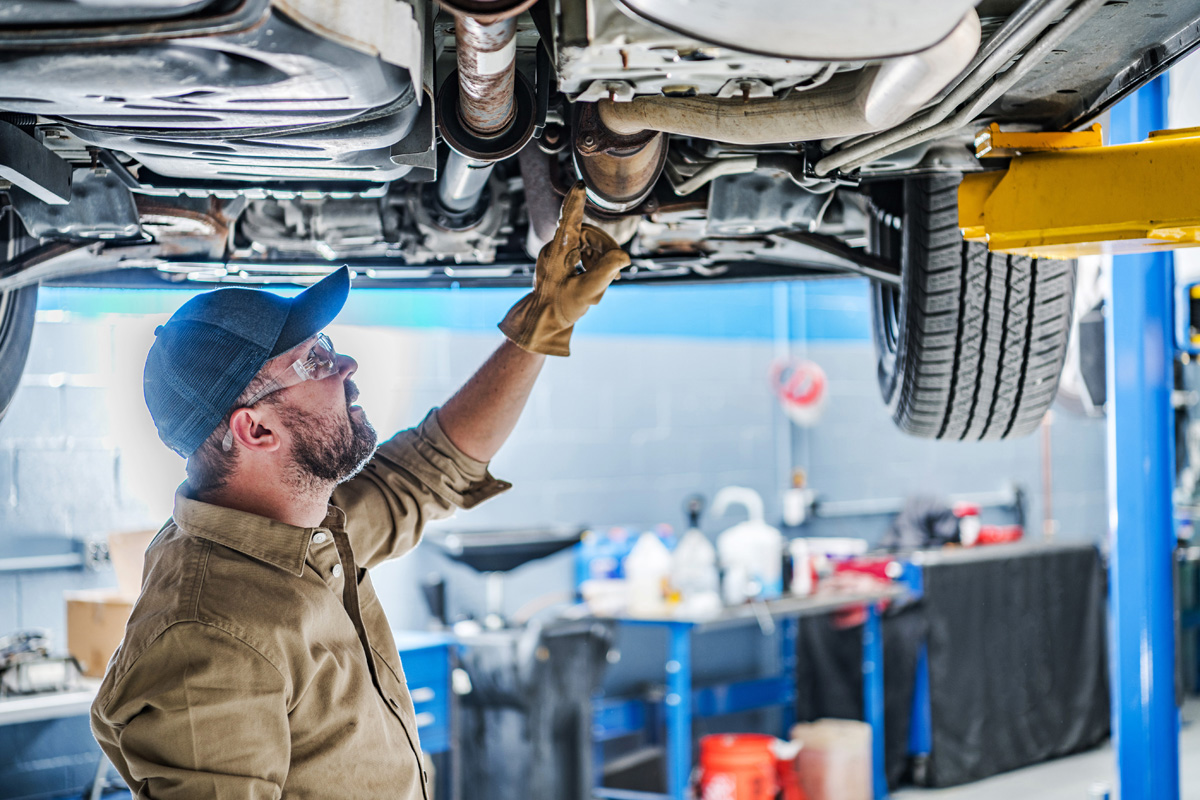
Most catalytic converters will not be too difficult to find and access. It will be easier to access if it is located under a vehicle instead of integrated in the exhaust manifold, as you may have guessed.
For instance, some converters will be welded in place and need to be cut out of the exhaust system. In other cases, the converter may be bolted into place but can still be tough to remove because the fasteners may become rusty over time.
How To Clean A Catalytic Converter
For a more thorough cleaning, it’s recommended to completely remove the converter. This process involves safely removing the component, using a degreaser and low-pressure water to wash away deposits, and then reinstalling the converter.
You’ll need the following tools for this process:
- Wrench set.
- Penetrating oil.
- Jack and jack stand.
- Low-pressure water source.
- Automotive degreaser.
Catalytic Converter Cleaning Steps
- Start by disconnecting the battery.
- This will prevent electrical hazards while work is being done on the sensors.
- Use the jack and jack stand to raise the vehicle on a level surface.
- Carefully unscrew and remove oxygen sensors.
- Unbolt the catalytic converter, at this time.
- Use the penetrating oil in the event the bolts are stuck.
- Spray degreaser inside and let it soak for several minutes.
- Gently flush out any debris with low-pressure water.
- Give the converter at least 24 hours to dry completely before reinstalling it.
- Reattach the converter, connect the oxygen sensors, and cautiously lower the vehicle back down.
How To Clean A Catalytic Converter Without Removing It
Oftentimes, cleaning the converter without removing it is the easiest and safest process overall. Doing it this way will avoid labor, risk, and necessary tools used for the removal.
Let’s take a look at two different ways to clean the converter without removing it.
High-Temperature Driving
- To clean the catalytic converter naturally, drive at highway speeds anywhere from 20-30 minutes.
- Keep the engine RPM steady.
- This means between 2,500-3,000 RPM.
- Ensure proper combustion by using quality fuel.
Fuel Additives
- Pour the recommended amount of catalytic converter into a fuel tank that is seemingly empty.
- Fill up your tank with fresh gasoline.
- Drive your vehicle normally, mixing in some highway driving.
- This allows the additive to work fully.
Live In The Scottsdale Area? Get Your Inspection Done At Bridwell Automotive Center!
Get your road trip inspection and preparation service done at Bridwell Automotive Center, located at 7171 E Lincoln Dr. Scottsdale, Arizona 85253 or call (480) 948-4781 for more information.